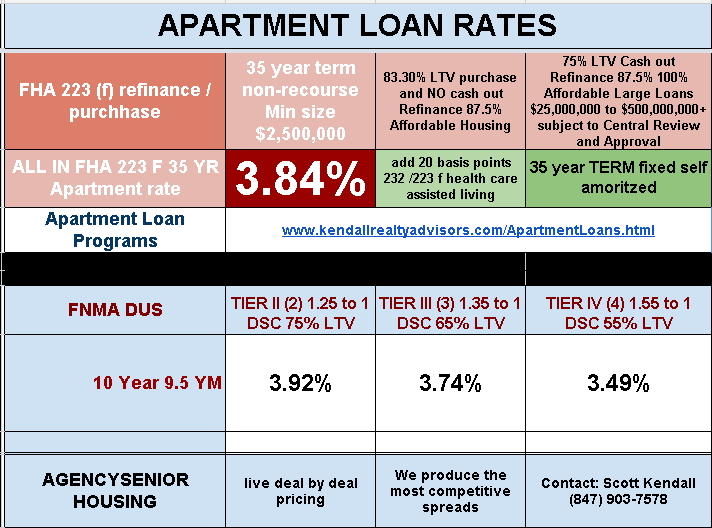
FHA 232 LEAN rates are near historic lows with most FHA 232 / 223 F deals closing with sub 4% rates plus MIP for 35 years.
The loan process still takes over 9 months for refinances and much longer for new construction. After adjusting the appraisal for FHA CAP Rate and all the other rules typically LTV for refinances are in 70% to 76% range.
Freddie Mac announced it is expanding its refinance program for senior housing and this may provide faster refinances for larger deals at slightly lower LTV. Call for a Quote.
For new construction and rehab deals that must close fast we have a an equity investor willing to joint venture that will provide conventional construction loan.
FHA Lean - Healthcare Lender - Lean program blog
Work with the best FHA 232 Lean Lending team, We are based in Chicago and provide national, full service multifamily and healthcare loans. We are the hardest working healthcare lending team in the USA.
FHA232/223f LEAN Refinance
FHA 232 New Construciton
FHA 242/FHA 223(f) Hospital Refinance NEW
Apartment Loan Programs
FHA 232 LEAN
232 New Construction Loans - 232 LEAN Refinance - A Leading lean lender - FHA 232 LEAN new construction loans
Saturday, May 28, 2011
Thursday, March 24, 2011
FHA 232 LEAN Letter
LOW INCOME HOUSING TAX CREDITS AND SECTION 232 NEW CONSTRUCTION/SUBSTANTIAL REHABILITATION PROJECTS:
Provided the Firm Applications are submitted in a timely manner, HUD reserves the right to adjust its Other Queue to give preference to processing new construction and substantial rehabilitation Section 232’s that include Low Income Housing Tax Credits (LIHTC) to meet placed in service deadlines on specific projects. We encourage lenders to submit the Firm Applications on these projects in such a manner that will allow as much time as possible for HUD to act on the applications – including reviewing whether our 2 Stage Firm Application process will provide for such.
CHANGES TO OUR PROCEDURE FOR HANDLING SEASONING OF DEBT:
The April 10, 2009 Email Blast discussed our definition of Eligible Debt and the two and five year seasoning rules. Although this language was silent on the date that the seasoning is based upon, we have consistently required that the two or five year period must have passed prior to the application being submitted (entering our queue). Because of the length of time that projects are spending in our queues, we are changing how we will handle this. Effective immediately, the two and five year time period will be based upon when a project is assigned to an OHP Underwriter (exits our queue). Lenders may choose to submit a project prior to the seasoning period expiring, however, if the project reaches the top of the queue prior to the debt being properly seasoned, the project will be placed on hold. Lenders submitting projects in such a manner must regularly monitor the project’s progression through the queue and contact a Workload Manager at HUD (prior to the project being assigned to an OHP Underwriter) if it becomes evident that the project will be assigned prior to the seasoning period expiring.
REFUNDS OF HUD APPLICATION FEE:
We understand that HUD is no longer issuing refund checks - all refunds are being handled by Direct Deposit. To accommodate this procedure, when requesting refunds in the future, please use the attached document as a template for your letter requesting the refund. This document will be posted to HUD.GOV in the future.
MANAGEMENT AGENT AND OPERATOR GRID:
Please see the attached grid. This document addresses HUD’s closing document requirements for operators and management agents to ensure that HUD has a valid security and regulatory interest in the project assets of the healthcare facility. Particularly of note, this grid addresses the document signing requirements of the operator and/or management agent for the operating lease, license, equipment, provider agreements, deposit accounts and facility repairs. This document will be posted to “Sample Closing Documents” on HUD.GOV in the future.
STALE DATE ON PHASE I ENVIRONMENTAL REPORTS:
We have been asked numerous times in the past few months to waive the stale date on Phase I Environmental Reports – listed in the endnotes on our Checklists. We have turned down all such requests as we are unable to waive this requirement.
CLOSING QUEUE:
We will soon be posting our closing queues to HUD.GOV. Until these are posted, please see the attached two spreadsheets, which list the projects in our closing queues. Projects will be assigned from the top to bottom of the spreadsheets. Currently we have three closing coordinators working on the non 223(a)(7) queue (one of these individuals concentrates on Insured Advances projects).
CLARIFICATION ON MINIMUM LEASE PAYMENTS:
During the closing of Section 232 loans, OHP and OGC have encountered confusion on the minimum lease payment required for closing documents and operating leases. For the actual leases, we are requiring that the annual lease payment be calculated using a minium of a 1.05 coverage ratio - annual principal + annual interest + annual mortgage insurance premium + annual reserve for replacement deposit + annual property and liability insurance + annual property taxes times a multiplier of 1.05. This minimum coverage level required for executed leases is different than the test measurement used in the 223 F Lender’s Narrative, which remains unchanged - it will continue at the 1.17 coverage level.
REVISED CONSTRUCTION SPECIFICATION TEMPLATE:
OHP will be following the revised construction specification template discussed in HUD Mortgagee Letter 2010-41 – see attached. All Firm Applications submitted to HUD on or after April 25, 2011, must use the new CSI MasterFormat 2010. Future revisions to our checklists and other documents posted to HUD.GOV will reflect this revised document.
CHANGES TO OUR STANDARD DOCUMENTS:
Please do not change Lean Approved exhibits posted on HUD.GOV. This includes, but is not limited to, submitting exhibits in MS Excel or QuattroPro when they are to be in original Word format, adding or subtracting fields of information in current documents, and changing language in Firm Commitments. When these changes are made it takes Underwriters and Closing Coordinators extra time to identify and mitigate these unapproved changes and is contrary to the standardization required under Lean. We will be following the February 19, 2010 Email Blast and requesting a revision to the Firm Application when this situation is present.
In addition, if a section of the Lender Narrative or an exhibit is not applicable to your project, please note that it is “not applicable” and explain why you believe this is not applicable. No sections are to be left blank or deleted from the Template. Your cooperation with this request will help us process your application more quickly.
MARKET INTEREST RATE ABOVE RATE USED IN SECTION 223(A)(7) APPLICATIONS:
Given the recent rise in interest rates, interest rates proposed in applications under Lean Section 223(a)(7) may not longer be achievable. Please advise your assigned OHP Underwriter if this is the case so you can work to ensure your application is consistently updated throughout to reflect a more accurate interest rate at the time of Firm Commitment issuance. For applications still in the queue that are no longer feasible due to interest rate hikes, lenders can opt to withdraw their application and have the application fee returned.
Need to Reference Previous LEAN 232 Updates?
Previous E-Newsletters (Email Updates) can be found at:
Friday, March 26, 2010
Monday, February 22, 2010
Wednesday, December 16, 2009
Guidance for Lenders for Market Rate Projects in Areas with Significant Adverse Economic Impacts:
FHA 232 LEAN Market Conditions - FHA LEAN UPDATE REPRINTED
Areas of Concern - California, Florida, Arizona, Nevada, Michigan, Ohio, Indiana, and Illinois
The following is guidance to LENDERS regarding temporary risk management initiatives that have been implemented by OIHCF regarding the review of new construction market rate projects in areas that have been impacted by significant adverse economic conditions. In essence, OIHCF has received a number of applications for projects in areas that have been hard hit by the current economic crisis. After a thorough review of the current conditions in those areas most affected by adverse economic events, OIHCF has determined that the approval of certain market rate projects in those areas would place the FHA insurance fund at an elevated risk for higher defaults and an increase in potential insurance claims.
OIHCF recently directed one of our most experienced appraisers to Florida and Arizona to assess the prevailing market conditions for “market rate” assisted living projects. The assessment conducted in Florida was mainly contained to the area south of Tampa including the Bradenton and Sarasota areas. We are aware that the Miami, Orlando and Ft. Myers/Naples markets as well as other areas of Florida have also been severely impacted by the housing crisis and are similarly impacted. Our analysis of those areas has demonstrated a very high rate of foreclosures, a high rate of delinquent properties not yet in foreclosure, higher unemployment rates and increasing stress with the commercial real estate portfolio. OIHCF has determined that the market for assisted living projects in those areas may be far weaker than the current marketing data otherwise indicates.
With respect to Arizona, OIHCF reviewed and analyzed the potential assisted living market for the major urban areas of the state. The conclusion of our analysis indicated that the potential market for market driven assisted living was severely impacted by the housing crisis, with large numbers of vacant properties, severe price reductions and serious evolving problems with commercial real estate. It is also noteworthy that many of the Section 232 applications had weak operating entities that had little or no experience with assisted living projects. OIHCF staff has noticed that some recently reviewed Market Acceptance/preapplications and their attached market have been projecting optimistic market data from 2-3 years ago which has been projected forward without fully accounting for the current serious economic realities that have altered the market characteristics for those and other markets. As a result of the findings of our appraisal staff, OIHCF is instituting the following action:
For example, but not limited to the following geographic areas, OIHCF has determined that all market driven assisted living projects in California, Florida, Arizona, Nevada, Michigan, Ohio, Indiana, and Illinois are to be underwritten with FULL RISK MITIGATION. All mortgage insurance applications for properties in those states will be subjected to a full appraisal review and a full review of the market study and if necessary, a more thorough economic analysis. Market studies must take into account the changing economic conditions of the market areas where the facility is located, and both Lender and OIHCF reviews should reflect that reality.
With respect to nursing homes, lenders and OIHCF staff will review the fundamentals of each project. If the nursing homes are contemplated to have a high percentage of private pay residents or otherwise have unusual marketing issues, OIHCF staff will also undertake full risk mitigation. However, if nursing home applications have Certificates of Need, a patient mix that reflects the current market, and other positive underwriting characteristics, then processing will proceed without any change to the current instructions.
OIHCF will continually review the prevailing market conditions and will make appropriate changes as market circumstances dictate.
Areas of Concern - California, Florida, Arizona, Nevada, Michigan, Ohio, Indiana, and Illinois
The following is guidance to LENDERS regarding temporary risk management initiatives that have been implemented by OIHCF regarding the review of new construction market rate projects in areas that have been impacted by significant adverse economic conditions. In essence, OIHCF has received a number of applications for projects in areas that have been hard hit by the current economic crisis. After a thorough review of the current conditions in those areas most affected by adverse economic events, OIHCF has determined that the approval of certain market rate projects in those areas would place the FHA insurance fund at an elevated risk for higher defaults and an increase in potential insurance claims.
OIHCF recently directed one of our most experienced appraisers to Florida and Arizona to assess the prevailing market conditions for “market rate” assisted living projects. The assessment conducted in Florida was mainly contained to the area south of Tampa including the Bradenton and Sarasota areas. We are aware that the Miami, Orlando and Ft. Myers/Naples markets as well as other areas of Florida have also been severely impacted by the housing crisis and are similarly impacted. Our analysis of those areas has demonstrated a very high rate of foreclosures, a high rate of delinquent properties not yet in foreclosure, higher unemployment rates and increasing stress with the commercial real estate portfolio. OIHCF has determined that the market for assisted living projects in those areas may be far weaker than the current marketing data otherwise indicates.
With respect to Arizona, OIHCF reviewed and analyzed the potential assisted living market for the major urban areas of the state. The conclusion of our analysis indicated that the potential market for market driven assisted living was severely impacted by the housing crisis, with large numbers of vacant properties, severe price reductions and serious evolving problems with commercial real estate. It is also noteworthy that many of the Section 232 applications had weak operating entities that had little or no experience with assisted living projects. OIHCF staff has noticed that some recently reviewed Market Acceptance/preapplications and their attached market have been projecting optimistic market data from 2-3 years ago which has been projected forward without fully accounting for the current serious economic realities that have altered the market characteristics for those and other markets. As a result of the findings of our appraisal staff, OIHCF is instituting the following action:
For example, but not limited to the following geographic areas, OIHCF has determined that all market driven assisted living projects in California, Florida, Arizona, Nevada, Michigan, Ohio, Indiana, and Illinois are to be underwritten with FULL RISK MITIGATION. All mortgage insurance applications for properties in those states will be subjected to a full appraisal review and a full review of the market study and if necessary, a more thorough economic analysis. Market studies must take into account the changing economic conditions of the market areas where the facility is located, and both Lender and OIHCF reviews should reflect that reality.
With respect to nursing homes, lenders and OIHCF staff will review the fundamentals of each project. If the nursing homes are contemplated to have a high percentage of private pay residents or otherwise have unusual marketing issues, OIHCF staff will also undertake full risk mitigation. However, if nursing home applications have Certificates of Need, a patient mix that reflects the current market, and other positive underwriting characteristics, then processing will proceed without any change to the current instructions.
OIHCF will continually review the prevailing market conditions and will make appropriate changes as market circumstances dictate.
Labels:
FHA 232 LEAN
Tuesday, August 18, 2009
FHA LEAN LENDER Assisted Living and Nursing Home Loans
FHA 232 LEAN loans = Assisted Living Facility Loans - Nursing Home Loan
Rates for refinance and purchases in high fives percent to low six percent including MIP.
See: FHA LEAN LENDER
Rates for refinance and purchases in high fives percent to low six percent including MIP.
See: FHA LEAN LENDER
Saturday, June 27, 2009
FHA, Fannie Mae, Freddie Mac rates come back down some!
With ten year treasuries having a good action last week, rates for healthcare and apartment loans came back down to the high 5% and low 6% range for refinances and purchase loans.
Subscribe to:
Posts (Atom)